
When They Call Home Crying

Last week, I moved my youngest daughter back into UNC Chapel Hill for her sophomore year.
Sophomore year. Not freshman year. We have actually done the drop-off together many times. This is my independent child. She attended boarding school. She went away to camp every summer. She travels with friends. She makes friends easily. She handles herself. She was definitely never the child I worried would be homesick.
And yet, there I was at the airport last week, waiting to board my flight home, when I got the text that she really needed to talk. I anxiously awaited her call, and when she finally rang, she was crying. Not a little teary. Full-blown, I cannot understand what you're saying kind of crying. And suddenly, all of my professional experience, nearly three decades of sending other people's children off to college, temporarily left my body.
Should I stay? Should I get out of this boarding line? I checked a bag, so if I run, this will cause an international incident, but I don’t care. Should I go back? Definitely. She should definitely drop out of college. Maybe she really needs me.
I went through the entire theatrical production in my head. I could picture myself dramatically abandoning my flight, returning to Chapel Hill and somehow making everything better. And then I had to remind myself of something I have told thousands of parents:
Missing home isn't the same as being in the wrong place.
And loving our children sometimes means tolerating their discomfort long enough for them to discover that they can move through it. And that is incredibly hard. So here are a few things for all of us to remember this time of year as we say our goodbyes this month:
Homesickness Doesn't Only Belong to Freshmen
One of the biggest misconceptions about homesickness is that it happens during those first few tearful days after freshman move-in. Sometimes it does, but sometimes September is wonderful.
Everything is new. The dorm is exciting. Orientation activities happen every five minutes. Everyone is introducing themselves. There are football games and parties, clubs to join, and hundreds of people desperately trying to make friends.
Then the dazzling newness wears off. The classes get harder. The roommate's habits aren't quite as charming. The first group of friends may not be your people. Everyone else's life looks fabulous on Instagram.
And suddenly you miss your dog, your bed, your mother's cooking, your high school friends, or simply the feeling of walking into a room where everyone already knows you.
Homesickness can come in October. It can hit after Thanksgiving, when students return to campus after sleeping in their own beds and being surrounded by people who love them without requiring any effort.
It can happen sophomore year, as I experienced last week!
It can happen after a breakup, after a bad grade, during rush, after being left out of something, or simply on a random Tuesday night when college doesn't feel the way they imagined it would.
Sometimes the College Calendar Makes It Worse
This is something I don't think we talk about enough: the academic calendar itself can contribute to homesickness.
My older daughter attended a college on the quarter system, and every April, almost like clockwork, she became homesick. Her friends at semester-based colleges were beginning to come home. Social media was filling up with pictures of friends finishing exams, packing their dorm rooms and heading home for summer.
Meanwhile, she still had six weeks of school left.
Six weeks doesn't sound terribly long until you're the college student watching everyone else return home while you're staring down another month and a half of classes, papers and exams.
April became hard for her. So instead of telling her, You're fine. It's only six more weeks, we created a little ritual. Every April or May, I went to see her.
We always planned something easy and fun. A meal somewhere fun with her roommates, some shopping, sleeping in a hotel, and yap and gossip sessions. It gave her something to look forward to and broke that long stretch between spring break and summer into two manageable pieces. And it was a win for both of us! Those weekends became some of my favorite memories.
I think the lesson is this, though:
Helping a homesick child doesn't always mean bringing them home.
Maybe it's a visit. Maybe it's tickets to a concert a few weeks away. Maybe it's sending a silly care package. Maybe it's planning a weekend with a sibling. Whatever it is, it is an opportunity to indicate: There is a marker ahead. You don't have to make it all the way to summer today.
Pay attention to your child's particular college calendar. Quarter systems, unusually late spring breaks, short Thanksgiving breaks, long stretches between holidays, and even friends at other colleges coming home earlier can affect them more than we realize.
So… What Do We Do When the Phone Rings?
First: listen. (This isn’t as obvious or as easy as it sounds.)
Our children say, "I hate it here," and our brains immediately start solving.
Should we transfer? Should I call someone? Should you come home this weekend? What about your roommate? Have you joined anything? Why don't you call that girl you met at orientation?
Stop. Sometimes "I hate it here" means exactly that. But sometimes it means:
"I had a terrible day, and I need to say this to the person with whom I feel safest."
Home - and you - are still their soft place to land. Try:
"I'm so sorry. That sounds really lonely."
"Do you want me to listen, or do you want me to help you think through what to do?"
That second question is one of my favorites because it keeps us from solving a problem our child hasn't asked us to solve.
A few things I would - and wouldn't - do
DO validate the feeling without validating every conclusion.
"I can understand why you feel lonely tonight" is very different from "Maybe this school was a mistake."
DON'T make a permanent decision during a temporary crisis.
One miserable weekend does not require a transfer application.
DO encourage small steps.
Go to class. Eat somewhere other than your room. Go for a walk. Ask someone to get coffee. Attend the club meeting even if you don't feel like going. Exercise. Find one familiar routine and repeat it.
Routines, campus involvement, maintaining reasonable connections with home, and actively seeking community are ways students can work through homesickness.
DON'T become their social cruise director from 700 miles away.
We cannot manufacture friendships for them. We cannot call the roommate. We cannot arrange their weekend. And unless there is a genuine health or safety concern, we shouldn't be emailing administrators every time they are unhappy.
DO keep communicating—but leave some room for college to become home, too.
A predictable Sunday FaceTime may be more reassuring than 17 texts a day asking, Are you okay? What are you doing? Who are you with?
Think about communication patterns because too much contact from home can sometimes make adjustment harder.
And, of course, DO recognize when this has moved beyond ordinary homesickness.
If your child is persistently unable to attend class, eat, sleep, leave the room or function normally—or you are seeing significant depression, anxiety, substance misuse or other concerning changes—this is no longer something to simply "wait out." Encourage them to connect with their college counseling center or another mental health professional.
I want to share a mistake I made with my own daughter.
For years, I have said something to my girls that I thought was lovely:
"I hope you meet your Auntie Lisa."
Lisa is my college best friend. More than 30 years later, she is still one of my closest friends. She knows my history. She has watched my children grow up. Our friendship is one of the great gifts of my life. So of course I want that for my daughters.
But I've started to wonder whether that is fair.
Because perhaps buried inside that sweet wish was another expectation:
College is where you are supposed to meet the best friends of your life.
What if you don't? What if you make nice friends, interesting friends, semester friends, roommate friends, study friends—and your lifelong person comes later? What if college is wonderful because of what you learn, who you become, and the confidence you develop, rather than because you found your "Auntie Lisa"?
Our children already have enough pressure to make college the best four years of their lives.
Maybe we should stop asking them to do that.
Maybe four years can simply be four important years—messy, joyful, lonely, exhilarating, disappointing, transformative years.
And what about us?
I think one of the hardest parts of parenting college-aged children is learning to separate their homesickness from our own.
When they say, "I want to come home," there may be a tiny voice inside us shouting:
YES. COME HOME. YOUR BED IS READY. I MISS YOU, TOO.
But our job is not to make ourselves indispensable. Our job is to build a home they know they can always return to while giving them enough confidence to build a life somewhere else. That may be one of the most painful forms of successful parenting.
One Final thought:
When my daughter called crying from Chapel Hill, I did get on the plane. Every maternal instinct in me wanted to turn around. But I went home. And she stayed.
We talked. She cried. I worried. And then the next day came. That's often how this works. Not with one dramatic moment when a child suddenly becomes independent, but with hundreds of tiny moments when they discover:
I was miserable last night.
I called home.
My parents loved me.
They didn't panic.
And I woke up the next morning and figured out what came next.
Maybe that is what we are really trying to give them, not a college experience without loneliness, rejection or homesickness, but the knowledge that they can experience those things and still be okay.
A Little Postscript: Apparently, We Never Completely Graduate
And lest I leave you with the impression that I have mastered any of this, I haven't. Not even close.
When my older daughter was in college, about 2000 miles away from me, she got very sick with mono and ended up in the ER. I remember the helplessness of being that far away when my child was sick; the overwhelming urge to get on a plane, get to that hospital, and make sure everyone understood exactly what was wrong and what she needed. You know - with the medical degree that I got on the internet.
I honestly thought perhaps that particular brand of maternal panic would disappear once college was over. Apparently not.
It happened again today.
That same daughter has now been out of college for more than a year. She lives in Nashville. She has a job, an apartment, and an adult life that is entirely her own.
And today, she ended up in the ER.
My immediate reaction?
I should get in the car.
Closely followed by:
Does that doctor understand what's going on? Should I talk to them? Maybe I need to explain her medical history...
And there it was again—that instinct to swoop in and take over, as if the doctors in Nashville had simply been waiting for my medical expertise to be like, Oh, great advice, lady.
So perhaps that's the real ending to all of this.
It does get easier. We do get better at letting go. But that doesn't mean we always handle it perfectly.
But apparently, there will always be a small part of us standing at an airport gate—or reaching for the car keys—thinking:
Are you sure you don't need your mother?
A Few Resources I Recommend
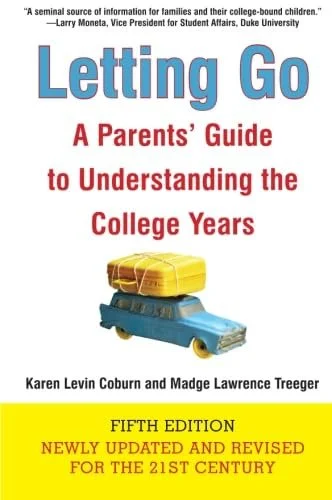
Letting Go: A Parent's Guide to Understanding the College Years — Karen Levin Coburn and Madge Lawrence Treeger
One of the classics for understanding the emotional transition from parenting a high school student to parenting an increasingly independent young adult.


The Jed Foundation (JED) — College Mental Health Resources
Excellent resources for both students and parents on homesickness, stress, finding community and recognizing when ordinary adjustment may have become something more serious.

Mental Health America — College Mental Health Resources
Practical information for young adults dealing with loneliness, anxiety, homesickness and the transition to college life.
To all of you dropping children off this month—or watching them drive away for the second or third time—I see you.
We spend so many years preparing them to leave.
No one tells us quite how much courage it takes not to follow them.